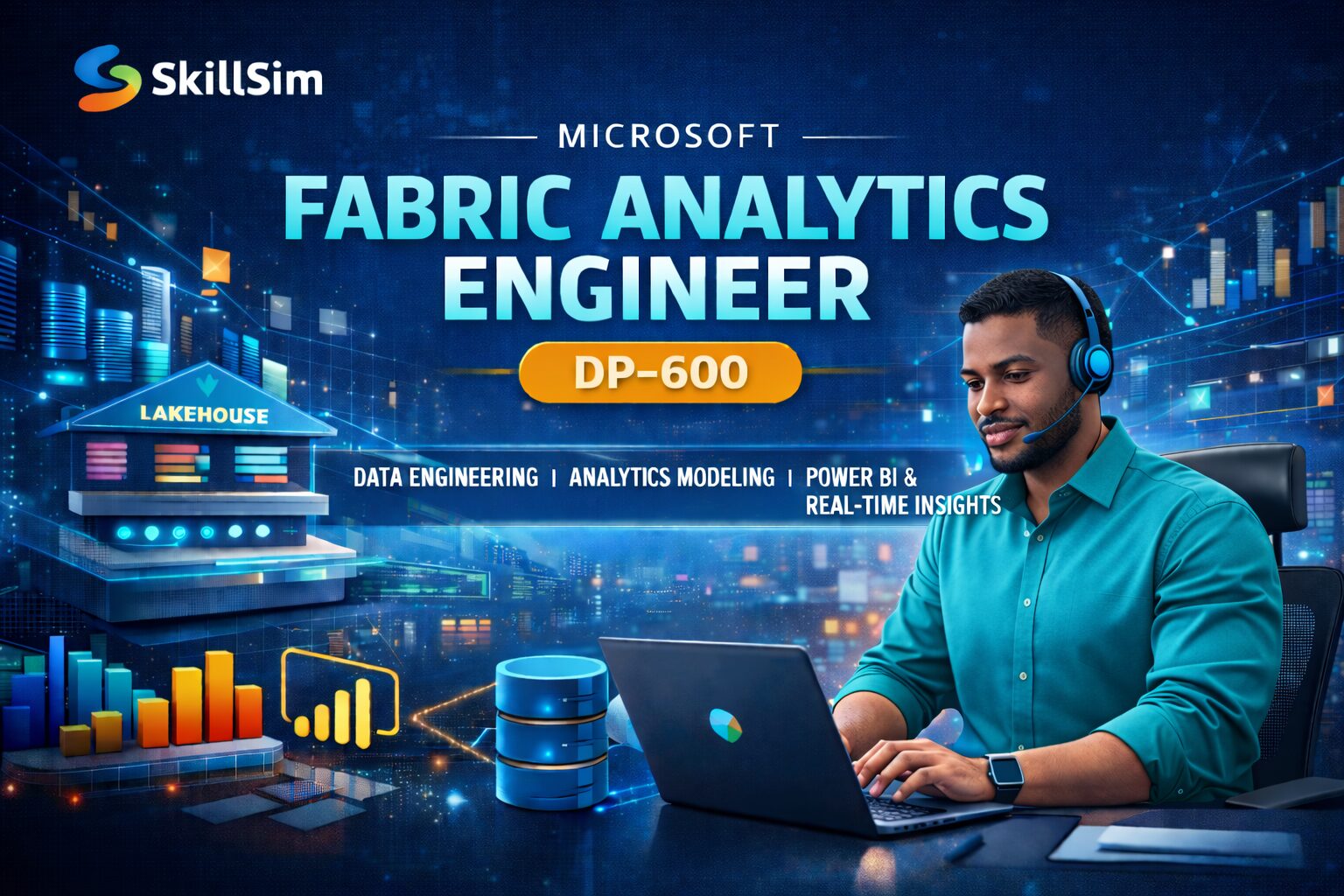
Microsoft Fabric Analytics Engineer (DP-600 Exam Ready)
Wishlist Share

About Course

Course Overview

The Microsoft Fabric Analytics Engineer (DP-600) course is a comprehensive, hands-on program designed to equip learners with the skills to design, build, and manage modern analytics solutions using Microsoft Fabric.

Learners will gain practical experience in:

  • Data engineering and integration
  • Analytics and semantic modeling
  • Real-time intelligence
  • Data governance and security
  • Business intelligence using Power BI

This course prepares learners to transform raw data into actionable insights and support AI-driven decision-making at scale.

Show More

What Will You Learn?

  • Build end‑to‑end analytics solutions using Microsoft Fabric’s unified platform
  • Design and develop scalable lakehouses, warehouses, and semantic models
  • Ingest, transform, and orchestrate data using Dataflows Gen2, Pipelines, and Notebooks
  • Optimize performance across storage, modeling, and reporting layers
  • Implement governance, security, and deployment pipelines for enterprise‑grade analytics
  • Create impactful Power BI reports connected to Fabric‑based semantic models
  • Apply best practices for analytics engineering, lifecycle management, and solution reliability

Course Content

Course Overview
The Microsoft Fabric Analytics Engineer (DP-600) course is a hands-on, industry-aligned program designed to equip learners with the skills to build modern data and analytics solutions end-to-end using Microsoft Fabric. From data ingestion to real-time analytics and business intelligence, this course empowers learners to transform raw data into actionable insights that drive decision-making and AI innovation.

Module 2: Data Ingestion & Integration
📖 Overview Learn how to connect, ingest, and prepare data from multiple sources into Fabric. 🔍 What You’ll Learn Dataflows Gen2 and pipelines Connecting to APIs, databases, and files Batch vs streaming ingestion strategies Data transformation using Power Query 🎯 Outcome Build robust data ingestion pipelines for analytics solutions.

Module 3: Lakehouse Architecture & Data Engineering
📖 Overview Explore how to design scalable data solutions using the Lakehouse paradigm. 🔍 What You’ll Learn Working with Delta tables Structuring raw, curated, and enriched data layers Using Spark notebooks for transformation Managing structured and unstructured data 🎯 Outcome Develop scalable data engineering solutions using Lakehouse architecture.

Module 4: Data Warehousing & SQL Analytics
📖 Overview Design enterprise-grade data models optimized for reporting and analytics. 🔍 What You’ll Learn Data warehouse design principles Star schema modeling (fact & dimension tables) Writing SQL queries for analytics Comparing Warehouse vs Lakehouse use cases 🎯 Outcome Create efficient data warehouse solutions for enterprise reporting.

Module 5: Semantic Modeling & DAX
📖 Overview Transform data into meaningful business insights using semantic models. 🔍 What You’ll Learn Building semantic models Creating relationships and hierarchies Writing DAX measures and KPIs Performance optimization techniques 🎯 Outcome Enable business-ready data models that support decision-making.

Module 6: Real-Time Analytics (Eventhouse & KQL)
📖 Overview Work with streaming data to deliver live insights and event-driven analytics. 🔍 What You’ll Learn Eventhouse and KQL fundamentals Streaming data ingestion Real-time dashboards and monitoring Event-driven analytics use cases 🎯 Outcome Deliver real-time intelligence and operational insights.

Module 7: Data Governance & Security
📖 Overview Ensure data is secure, compliant, and governed across the enterprise. 🔍 What You’ll Learn Role-Based Access Control (RLS, CLS) Sensitivity labels and data protection Data lineage and impact analysis Governance best practices 🎯 Outcome Implement secure and compliant analytics environments.

Module 8: Power BI & Data Visualization
📖 Overview Design compelling dashboards and reports for business users. 🔍 What You’ll Learn Building interactive dashboards Designing effective visualizations Using Direct Lake for high performance Sharing and collaboration 🎯 Outcome Deliver insightful dashboards that drive business decisions.

Module 9: End-to-End Analytics Solution
📖 Overview Bring everything together into a complete analytics solution. 🔍 What You’ll Learn Designing end-to-end architectures Integrating all Fabric components Performance optimization Aligning analytics with business use cases 🎯 Outcome Build and deploy a complete enterprise analytics solution.

Capstone Project (SkillSim Simulation)
🚀 Final Project Learners will: Design a Fabric architecture Build ingestion pipelines Create semantic models Develop dashboards Implement governance 💡 Based on a real-world enterprise AI transformation scenario

Student Ratings & Reviews

No Review Yet
No Review Yet